
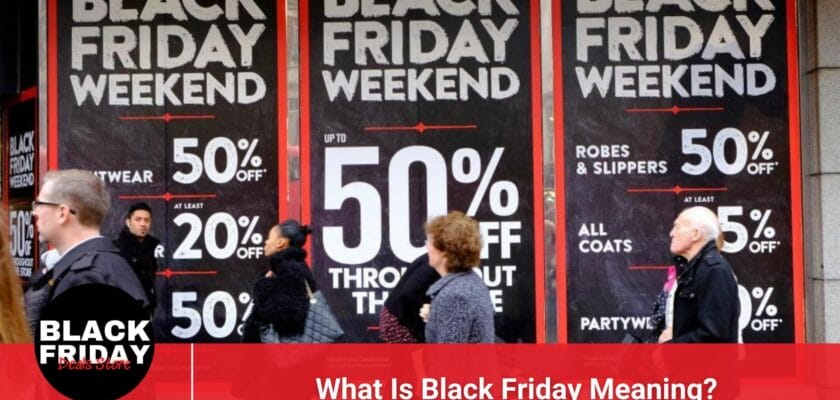
Straight answer: Black Friday means the major shopping period that begins on the Friday after Thanksgiving in the United States.
The name describes both a retail tradition and a large sales event, when stores and websites promote limited-time offers before the holiday season.
The Black Friday meaning matters because the phrase now covers more than one busy shopping day.
It can describe store promotions, online events, advertising campaigns, and the wider start of holiday purchasing.
Knowing the term helps shoppers understand what retailers mean when they announce an early deal, a doorbuster, or a sale that continues beyond Friday.
Black Friday does not guarantee that every offer is the best choice. Retailers can use the name for different products, time windows, and conditions.
A clear definition helps you compare the final cost, read restrictions, recognize urgency tactics, and decide whether a purchase fits your needs before the holiday shopping season becomes crowded.
The basic Black Friday definition
Black Friday is the Friday after Thanksgiving in the United States. It is associated with unusually active retail shopping and promotions for holiday purchases.
Stores may advertise special offers in physical locations, on websites, or through apps.
The phrase can also describe the broader promotional period surrounding that Friday, rather than a single opening hour.
The event is not an official federal holiday. Many businesses open, close, or change hours according to their own policies.
Some employers and schools may observe the day after Thanksgiving, but that does not create one nationwide retail schedule.
Shoppers should check each seller’s current hours, delivery terms, and product availability before making plans.
The word Black in this context does not mean that the products, shoppers, or holiday are negative. It is a historical label whose meaning changed over time.
Modern usage usually signals a period of heavy shopping activity and competitive advertising. The phrase does not itself prove that an item has its lowest possible price.
The event often overlaps with other retail terms, including early Black Friday, Black Friday week, and Cyber Monday. These labels can refer to different offers from the same seller.
Read the promotion’s start and end conditions instead of assuming that every advertised deal follows the traditional Friday schedule.
Read this Black Friday history for background on the term’s changing meaning and retail tradition.
Where the name came from
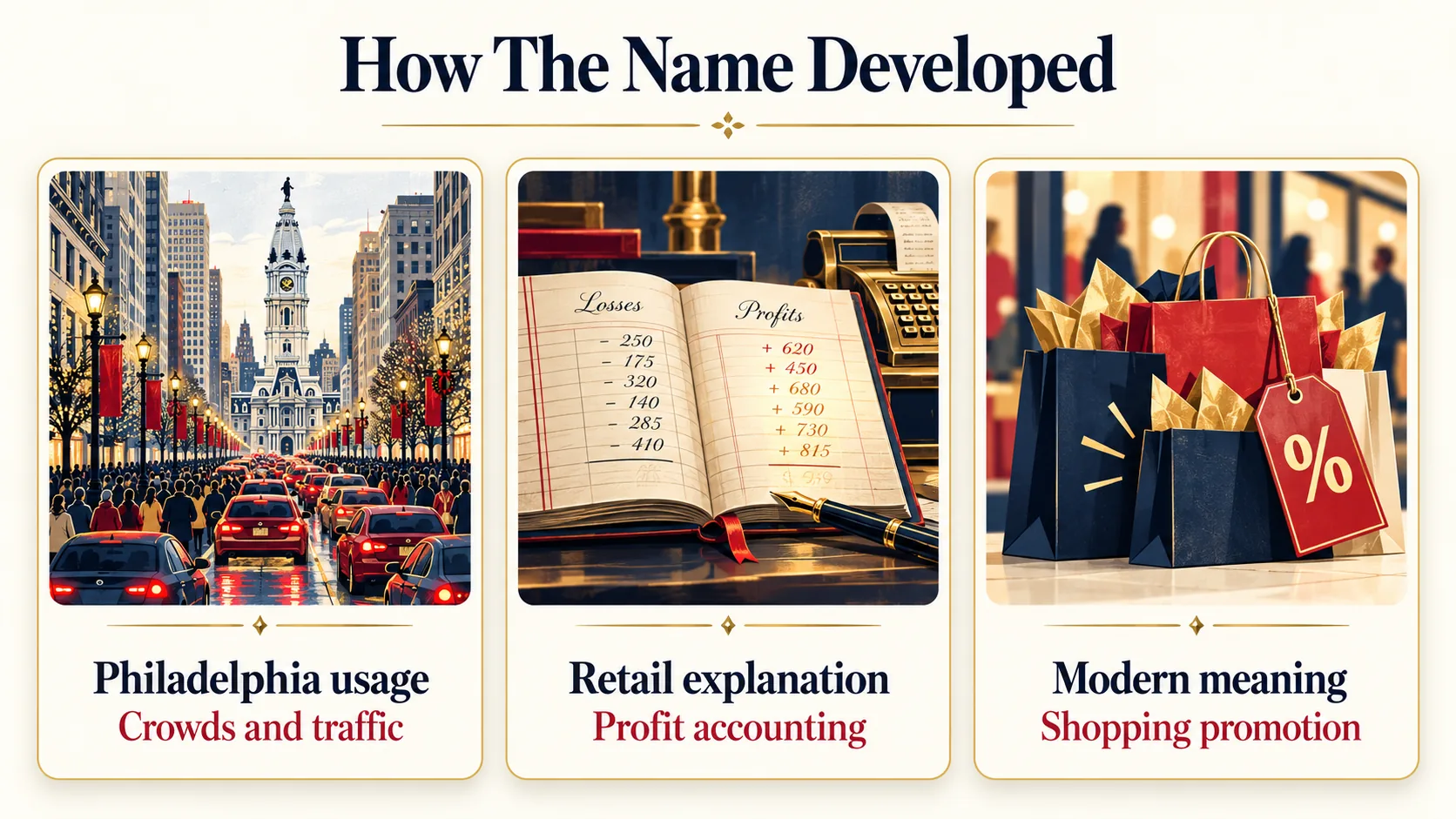
The modern retail explanation is often connected with accounting language. Businesses have traditionally described losses with red ink and profits with black ink.
Retailers later used this idea to suggest that strong holiday sales could help annual results move into profit. This explanation is memorable, but it was not the original public meaning of the phrase.
A widely cited earlier use came from Philadelphia.
Police reportedly used Black Friday to describe the difficult traffic, crowds, and disorder connected with the Army-Navy football weekend and post-Thanksgiving shopping.
That local use carried an unfavorable meaning and referred to managing public activity, not store profits.
Retailers eventually promoted the more positive accounting explanation because it made the name sound commercially useful.
The revised story helped businesses present the event as an important opportunity rather than a problem for city services.
Historical accounts show that popular explanations can simplify how a term developed.
Understanding the name’s history prevents a common mistake. Black Friday was not named because shoppers receive black-colored products or because the event has a dark cultural meaning.
The phrase developed through public usage, news coverage, and retail marketing. Its current meaning is now mostly understood as a large shopping promotion.
Federal Reserve consumer resources explain practical issues involving payments, credit, and financial decisions.
How the shopping tradition developed
Black Friday became strongly linked with the start of the holiday shopping season because many Americans begin gift buying after Thanksgiving.
Retailers noticed the attention and built promotions around that timing.
Store displays, newspaper advertisements, television commercials, email campaigns, and online listings helped turn a regional expression into a national retail tradition.
Shopping gradually moved beyond physical stores. Online retailers added timed promotions, digital coupons, app alerts, and shipping incentives.
This change made the event available to people who do not want to visit crowded locations.
It also made comparison easier, although online listings can change quickly and may use different product numbers or conditions.
Retailers began spreading promotions across a longer period. Some launch offers before Thanksgiving, while others reserve selected products for the Friday after Thanksgiving.
Cyber Monday later became associated with online shopping after the weekend. These labels now overlap, so shoppers should focus on the terms attached to each offer.
The tradition also affected consumer planning. People may create gift lists, track product availability, and set spending limits before promotions begin.
A written plan reduces impulse buying and makes it easier to compare alternatives. The history of Black Friday explains why the event remains important, but it does not require anyone to shop.
NIST online security guidance offers practical steps for protecting accounts and information during online shopping.
What Black Friday promotions include
A Black Friday promotion can include a temporary price reduction, a bundle, a gift card condition, free delivery, or an offer limited to a particular membership group.
The name alone does not explain the benefit. Read the product description, eligibility rules, included accessories, and return policy before judging an offer.
Some promotions use limited quantities or limited time windows. A retailer may show a countdown, announce a scheduled launch, or limit a purchase to one unit per customer.
These conditions affect availability and convenience. They can also make a fast decision feel necessary, so confirm the details before entering payment information.
A doorbuster usually means a heavily promoted item available in restricted quantities or during a restricted period. It may be sold in a store, online, or through both channels.
A doorbuster is not automatically a better product or a better overall value. Compare specifications, warranty terms, delivery costs, and replacement needs.
For a practical explanation of the wider process, read how the sales actually work.
Then compare the final checkout total with comparable products. This approach separates the marketing label from the features and conditions that determine whether the purchase makes sense.
How shoppers should compare offers
Start with the exact model, size, color, storage capacity, or configuration. Similar products can have different specifications and different product identifiers.
A listing that looks equivalent may include fewer accessories or a shorter warranty. Confirm the full description before comparing one seller’s advertised offer with another seller’s listing.
Check the total cost rather than the headline claim. Add delivery charges, required memberships, taxes where shown, installation fees, and optional accessories.
A promotion may also require a coupon code or a particular payment method. These details determine the amount you will actually pay and the steps needed to receive the advertised terms.
Review return and warranty policies before buying. Seasonal purchases may have different return deadlines, restocking charges, or exclusions for opened products.
Manufacturer coverage can also vary by seller and model. Keep the receipt, confirmation email, and product information until the return period and warranty process are no longer relevant.
Use a shopping list and a budget to control urgency. Record acceptable alternatives, the features that matter, and the maximum amount you plan to spend.
If an offer does not meet those requirements, skipping it is a valid decision. Black Friday is a buying opportunity, not a requirement to purchase.
Black Friday safety and shopping risks
Scammers often imitate seasonal promotions through fake websites, messages, and social media advertisements.
Check the web address carefully and avoid links that use unusual spelling or pressure you to act immediately.
Use a known retailer address or a saved bookmark instead of trusting an unexpected message.
Protect payment and account information by using strong, unique passwords and multifactor authentication where available. Avoid entering sensitive details on public networks when possible.
A payment method with dispute protections can provide another layer of help if an order is not delivered or a seller is fraudulent.
Read reviews with care because reviews may describe different versions, sellers, or older models. Confirm who fulfills the order and who handles returns.
Marketplace listings can involve third-party sellers whose policies differ from the platform’s general customer service terms.
Watch for misleading comparison claims. A reference price may reflect a previous listing, a suggested price, or a price that applied under different conditions.
Look for the item’s specifications and final terms instead of relying only on a large discount label. Save screenshots of important conditions when an offer may change.
Black Friday versus Cyber Monday
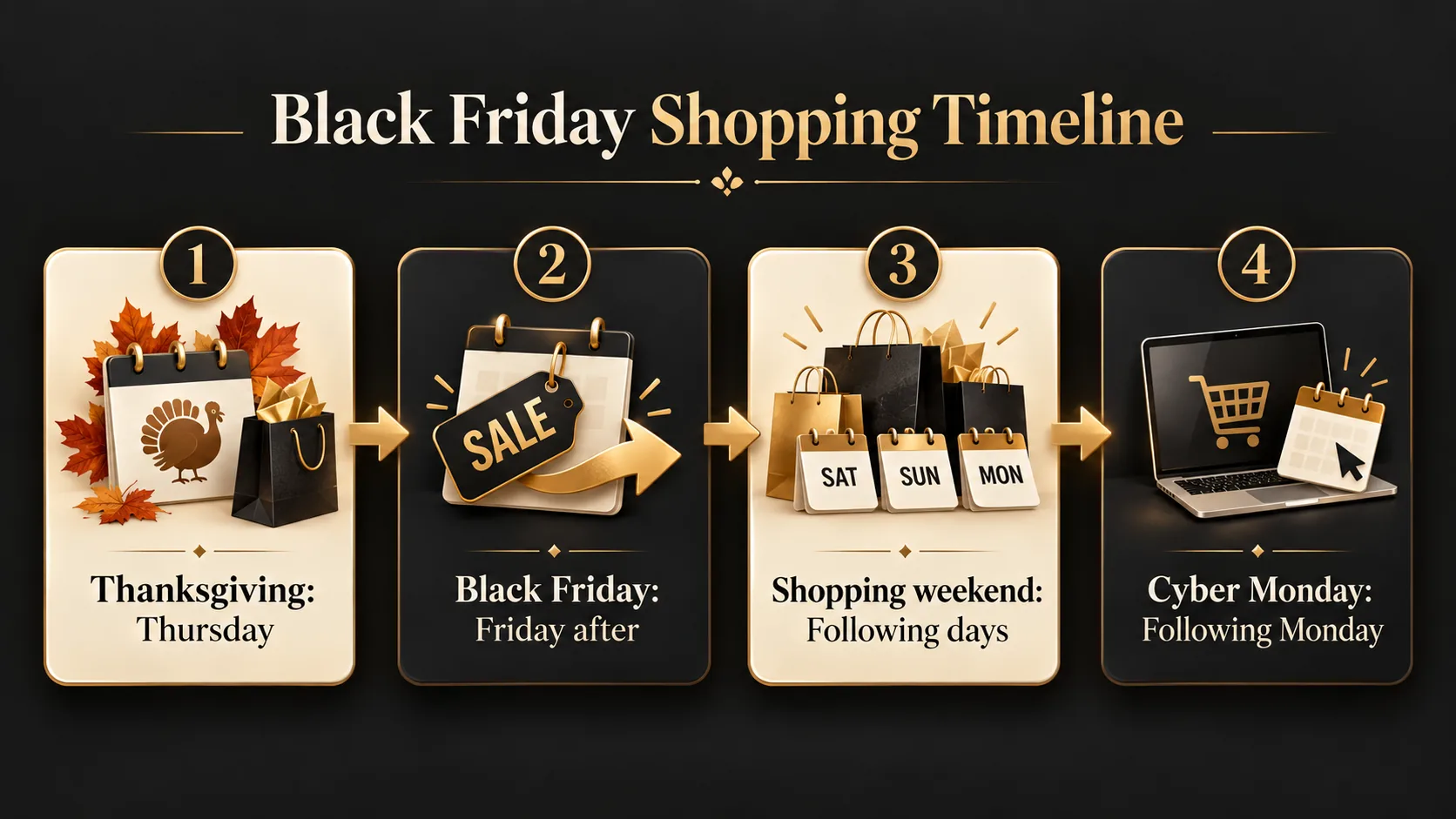
Black Friday traditionally refers to the Friday after Thanksgiving. Cyber Monday refers to the Monday that follows that weekend and is associated with online promotions.
The two events developed separately, but retailers now use both names across stores, websites, applications, and email campaigns.
The difference is therefore more about timing and marketing history than a strict shopping rule. A Black Friday offer may be online, while a Cyber Monday offer may appear in a physical store.
Some sellers run one promotion across both periods, and others change products or terms between them.
Compare the offer itself rather than choosing a label. Check the product specifications, stock status, delivery promise, return policy, and final checkout amount.
A Cyber Monday listing is not automatically better for technology, and a Black Friday listing is not automatically better for household goods or gifts.
The best time to buy depends on your need, research, and acceptable alternatives. If a suitable item appears under clear terms, waiting for a named event may add risk.
If the purchase is flexible, monitoring both periods can reveal different availability and conditions without assuming that one day always wins.
Frequently asked questions
What does Black Friday mean?
Black Friday means the Friday after Thanksgiving in the United States and the major shopping promotions associated with that period. Retailers may advertise offers in stores and online.
The phrase can also describe a longer promotional season, so each seller’s timing, stock, and conditions need separate checking.
Why is it called Black Friday?
The name has an earlier association with Philadelphia police describing heavy traffic and crowds after Thanksgiving.
Retailers later promoted an accounting explanation involving businesses moving from red ink to black ink.
The retail explanation became popular, but the term’s history is more complicated than that single story.
When does Black Friday happen?
Black Friday happens on the Friday after Thanksgiving in the United States. Promotions may begin earlier or continue through the weekend and into Cyber Monday.
Check the individual retailer’s start time, end time, stock limits, and eligibility rules because there is no single schedule for every seller.
Is Black Friday a federal holiday?
No. Black Friday is not a federal holiday in the United States. Businesses may change their hours, and some employers or schools may close, but practices vary.
Confirm store hours and delivery expectations directly with the retailer before traveling or arranging a time-sensitive purchase.
Are Black Friday deals always the lowest price?
No. The Black Friday label does not guarantee the lowest price. Compare the exact model, total checkout cost, return policy, and warranty with other sellers.
A promotion may involve limited stock, a coupon, membership, or different specifications that affect its actual value.
What is the difference between Black Friday and Cyber Monday?
Black Friday traditionally refers to the Friday after Thanksgiving, while Cyber Monday refers to the following Monday and has an online-shopping association. The distinction is now flexible.
Retailers can run either promotion online or in stores, so compare the offer’s terms rather than relying on the name.
What is a Black Friday doorbuster?
A doorbuster is a highly promoted offer that usually has limited quantities, a restricted time window, or both. It may be available online, in stores, or through separate channels.
Check specifications, purchase limits, delivery terms, and return rules before deciding that it is a suitable deal.
How can I avoid Black Friday scams?
Use a retailer’s known web address, check spelling carefully, and avoid unexpected links that create urgent pressure.
Review seller information, payment protections, return terms, and delivery promises. Use strong account security and keep order records. If the offer seems unclear, do not enter payment details.
Should I wait for Black Friday to buy something?
Wait only if the purchase is flexible and you have compared acceptable alternatives. A suitable offer may sell out, change terms, or arrive too late for your need.
Set a budget and product requirements first, then decide whether waiting provides a meaningful advantage without creating unnecessary risk.
More Black Friday and Cyber Monday guides
Planning the rest of your Black Friday? These cover the same shopping window:

