

The gist: Cyber Monday is the first Monday after Thanksgiving, so the number of days remaining changes each year. Use a current calendar to count from today to that Monday.
Start deal research before Black Friday, then set alerts and review shipping terms before Cyber Monday begins.
The answer to how many days until Cyber Monday depends on today’s date because the shopping event follows Thanksgiving rather than a fixed calendar date.
Cyber Monday always arrives on the Monday after Thanksgiving, after Black Friday and the weekend that follows.
Knowing the timing helps shoppers organize research, watchlists, retailer emails, delivery checks, and purchase decisions before popular inventory becomes harder to find.
A countdown matters because Cyber Monday promotions can begin early and may change during the weekend.
Use the date rule to identify the correct Monday, then create a simple plan for comparing products and checking return terms. The best preparation is not waiting for a countdown to reach zero.
It is collecting reliable information before the event makes shopping decisions feel rushed.
Cyber Monday Date Rule
Cyber Monday is the first Monday after Thanksgiving in the United States. Thanksgiving occurs on the fourth Thursday of November, so Cyber Monday follows four days later.
This rule explains why Cyber Monday does not have one permanent date.
A calendar can identify the exact Monday for the current shopping season without relying on an outdated countdown printed elsewhere.
The event follows Black Friday by three days. Black Friday is the Friday after Thanksgiving, followed by Saturday and Sunday, then Cyber Monday.
This sequence gives shoppers a useful framework for planning.
Research can begin before Thanksgiving, in-store or online comparisons can happen over the weekend, and final online checks can be reserved for Cyber Monday.
A countdown widget may show different results depending on its time zone, update schedule, or definition of the end of the day. Check the displayed time zone before treating the result as exact.
Retailers can also launch promotions before the official event or continue them afterward. The date rule identifies the shopping occasion, but each retailer controls its own promotion schedule.
To calculate the countdown, locate Thanksgiving on a current calendar, move to the following Monday, and count complete days from today. If today is Cyber Monday, the remaining count is zero.
If the event has passed, the next relevant Cyber Monday is in the following shopping season. This method avoids confusing last season’s date with the upcoming event.
If you want the full background, read our Black Friday explainer.
Use the Thanksgiving calendar rule to identify the Thursday that determines the Cyber Monday sequence.
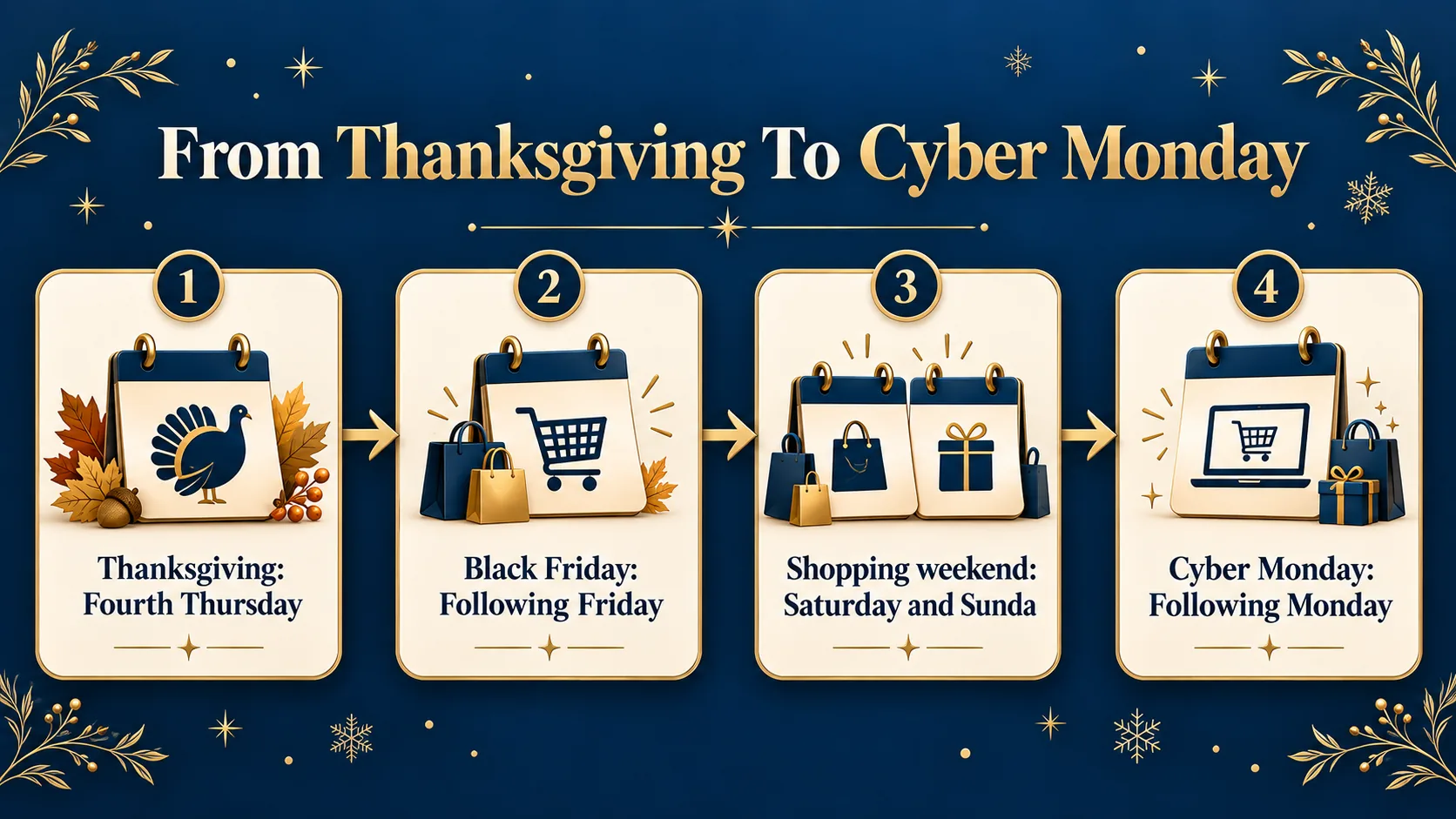
Why The Countdown Changes
The countdown changes because Thanksgiving moves within November. It is tied to the fourth Thursday, not to a fixed numbered date.
Cyber Monday therefore moves with it while keeping the same weekday relationship.
A shopper checking the countdown months in advance may see a different number after crossing a month boundary, even though the event’s scheduling rule has not changed.
Time zones create another difference between countdown tools. A timer based on Eastern Time may reach zero before one based on Pacific Time.
Retailers may publish opening times in their own local time or use a nationwide launch moment. Check the retailer’s stated time and your device settings when a promotion has a strict start or end.
The phrase Cyber Monday can also describe a broad promotional period rather than one day. Some retailers begin online offers before the Monday, while others extend them through the week.
Early access may apply to email subscribers, loyalty members, or selected products. Treat the official Monday as a reference point, then confirm the live terms for each item.
A reliable countdown should identify its time zone and refresh regularly. It should also make clear whether it counts until the start of Monday or the end of Monday.
If those details are missing, use a standard calendar and the retailer’s event page instead. The calendar supplies the date, while retailer information supplies the actual shopping window.
Read this Cyber Monday background for the event’s history and relationship to online shopping.
Black Friday And Cyber Monday
Black Friday and Cyber Monday are connected parts of the same shopping period, but they are not the same event. Black Friday occurs on the Friday after Thanksgiving.
Cyber Monday occurs on the following Monday. The three-day gap includes the weekend, when retailers may update product availability, promotion terms, or delivery estimates.
The names no longer describe strict shopping channels. Black Friday promotions can appear online, and Cyber Monday promotions can involve stores as well as websites.
The label may still signal a retailer’s preferred timing, but it does not guarantee that an item is online-only. Read the offer details instead of assuming where a purchase must be completed.
Use Black Friday for an early comparison point and Cyber Monday for a later review. A product may have the same offer across both events, or the retailer may change the offer between them.
Waiting can reduce availability, while buying too early can limit comparison. Decide in advance which product features and terms matter enough to act.
The weekend between the events is useful for checking updated information. Review stock status, delivery estimates, return rules, warranty details, and any membership requirement.
Avoid comparing only headline wording. A lower advertised total may involve shipping charges, required subscriptions, bundled accessories, or a limited purchase window that does not fit your needs.
Consult measurement standards guidance when comparing product dimensions, capacity, or technical specifications.
Build A Countdown Plan
Start with a product list divided into needs, possible upgrades, and items to ignore. Record the model name, important specifications, acceptable alternatives, and the retailer offering the item.
This reduces rushed searching when promotions appear. A focused list also makes it easier to notice when a deal changes the product rather than simply changing its price.
Create alerts for products that have a specific model or feature requirement. Choose notifications that include stock changes, promotion launches, or retailer messages.
Too many alerts can make every message appear urgent, so limit them to products you would buy after checking the full terms.
Turn off alerts after the shopping period to avoid unnecessary future messages.
Use the days before Cyber Monday to research compatibility and ownership needs.
Check device connections, dimensions, software support, replacement parts, installation requirements, and included accessories. For gifts, confirm recipient preferences and delivery timing.
Research completed before the event leaves more time for a calm comparison when multiple offers appear at once.
Set a personal decision deadline before the event begins. Decide which items justify immediate action, which can wait, and which require a second review.
Keep a record of the product page and terms at the time of purchase. This creates a useful reference if the promotion changes later or if customer service needs details about the order.
Check postal service resources for delivery planning, tracking information, and seasonal shipping considerations.
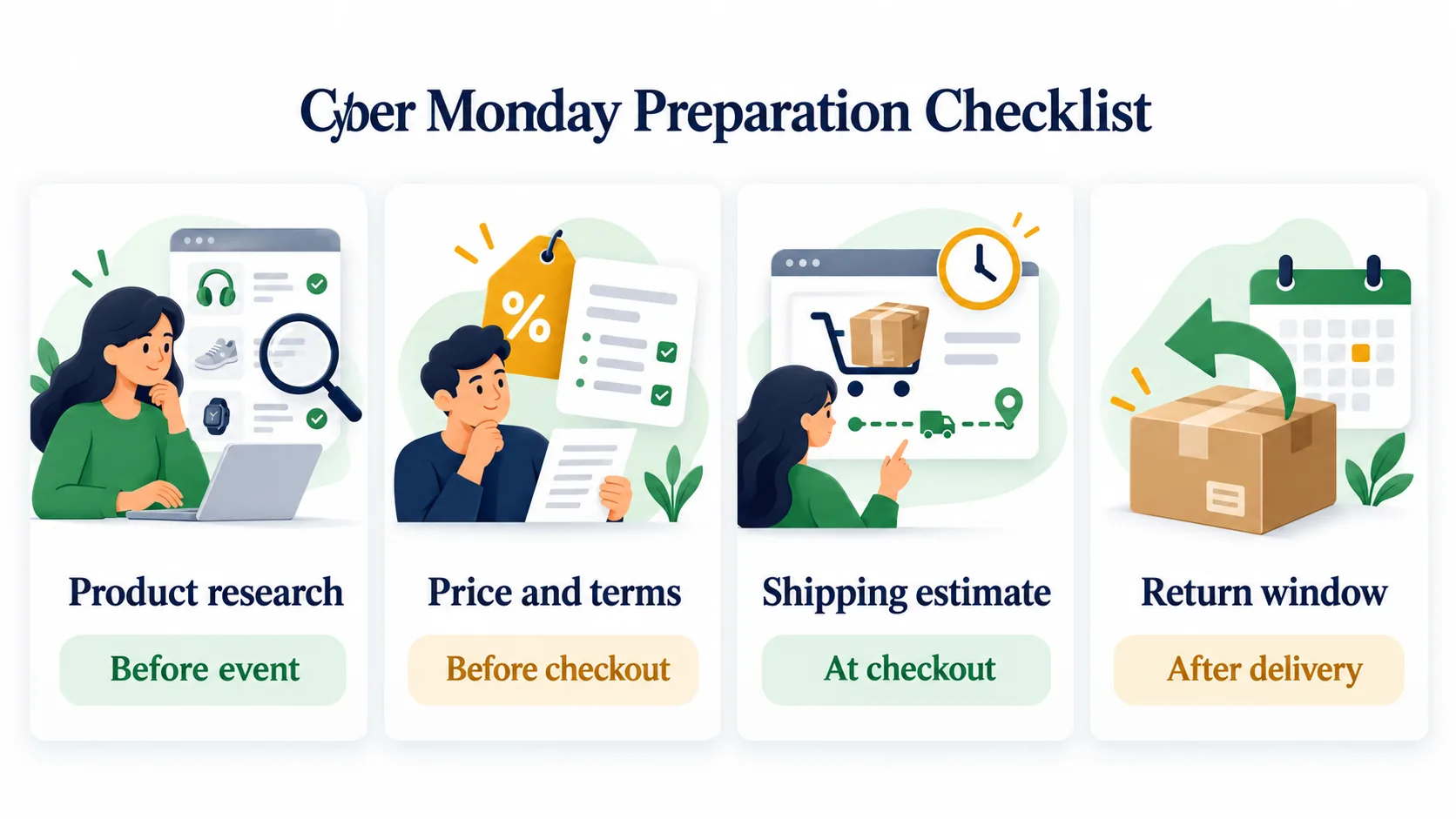
Check Deal Terms First
A Cyber Monday offer is useful only when its conditions fit your purchase. Check whether the offer applies to the exact model, color, size, configuration, or seller in your cart.
Marketplace listings can show similar products from different sellers, and the headline promotion may apply to only one listing or product variation.
Review exclusions before making a decision. Terms may exclude gift cards, clearance items, selected brands, bundled products, or purchases made through particular channels.
A promotion may also require a code, account, payment method, or membership. Keep the terms open while completing checkout so you can confirm that the expected offer appears.
Return rules deserve the same attention as promotion wording. Check the return period, restocking conditions, return shipping responsibility, final-sale exclusions, and the date the period begins.
Electronics, personalized goods, opened software, and hygiene products may have special restrictions. A convenient promotion is less useful if the product cannot be returned when it does not fit.
Save important order information after checkout. Keep the confirmation, item description, seller identity, delivery estimate, and terms connected to the purchase.
Use a trusted payment method and review the final total before submitting. The countdown should support careful shopping, not pressure you to skip basic checks that protect the purchase.
Shipping Before The Holidays
Cyber Monday falls close to the holiday delivery rush, so shipping deserves early attention.
An estimated arrival window is not always a guarantee, especially when inventory moves between warehouses or carriers experience high volume.
Compare the promised window with the date the item is needed, not only with the date the order is placed.
Check whether an item ships from the retailer, a marketplace seller, or a third-party warehouse. Those sources can use different handling times, carriers, and return procedures.
A product marked available may still need processing before shipment. Look for separate delivery estimates when a cart contains items from multiple sellers or fulfillment locations.
For gifts, leave time for inspection after delivery. The recipient may need the correct size, compatible accessory, or undamaged packaging.
If a problem appears near a holiday deadline, replacement stock and support availability may be limited.
Earlier planning gives you more options than a purchase made at the end of the promotional window.
Consider shipping fees, pickup options, and delivery restrictions before comparing offers. A free or low-cost method may take longer, while expedited service may change the total.
Confirm the address, apartment information, and contact details at checkout. Track the shipment through the carrier or retailer, and report unexpected delays through the stated support channel.
Track Availability Carefully
Popular products can move in and out of stock during the Black Friday to Cyber Monday period. An unavailable item may return, but no retailer can promise a restock time unless it states one.
Keep a short list of acceptable alternatives with similar features so one unavailable listing does not control your entire decision.
Compare the exact product identifier when checking another retailer. Names can look similar while specifications, included accessories, warranties, or regional versions differ.
Model numbers are more dependable than photographs or short titles. Confirm that the seller is authorized when warranty support matters, especially for electronics and appliances.
Stock messages can be useful but are not proof that an item will remain available through checkout. Add-to-cart status, shipping estimates, and final order confirmation provide different information.
A product may be visible on a page while a selected configuration is unavailable. Recheck the variation and delivery method before paying.
Avoid treating scarcity language as a reason to skip research. Messages such as limited quantity or selling fast may reflect current inventory, a short promotion, or a marketing prompt.
Use the countdown to organize decisions, not to abandon them. If the product is a genuine need, compare the terms and alternatives before choosing whether to buy.
Before you buy: your questions
How many days until Cyber Monday?
The number depends on today’s date. Cyber Monday is the first Monday after Thanksgiving, so count from today to that Monday on a current calendar.
A countdown tool may differ because of time zones or because it counts to the start rather than the end of the shopping day.
When does Cyber Monday happen?
Cyber Monday happens on the Monday after Thanksgiving in the United States. It follows Black Friday by three days.
Retailers may begin online promotions earlier or extend them afterward, so use the date as a reference point and check each retailer’s active schedule.
Is Cyber Monday always on a Monday?
Yes. Cyber Monday is defined by its weekday relationship to Thanksgiving. It is the first Monday after Thanksgiving. The calendar date changes from season to season, but the weekday does not.
Retailers can run related offers on other days without changing the official event’s timing.
Is Cyber Monday better than Black Friday?
Neither is automatically better. Black Friday and Cyber Monday offers can overlap, differ by product, or use separate terms.
Compare the exact item, availability, shipping, return rules, and total checkout conditions. Choose the timing that offers the best fit rather than relying on the event name.
Do Cyber Monday deals start early?
Many retailers begin promotions before Cyber Monday, sometimes during the weeks leading to Thanksgiving or over the preceding weekend. Early access can have separate requirements and terms.
Check official retailer messages and product pages instead of assuming that every early offer will continue until Monday.
How should I prepare for Cyber Monday?
Create a focused product list, research specifications, set alerts, compare acceptable alternatives, and review return and shipping rules.
Confirm whether an offer needs a code, account, membership, or payment method. These steps reduce rushed decisions when several promotions and stock changes happen together.
Can Cyber Monday deals sell out?
Yes. A promotion can end because inventory, selected configurations, or the promotion period is limited. Availability can also vary by seller and fulfillment method.
Keep alternative products ready, verify the exact model in your cart, and confirm the delivery estimate before completing the purchase.
When should I check Cyber Monday shipping?
Check shipping before buying, then review the estimate again at checkout. Cyber Monday occurs near the holiday delivery rush, and handling times can differ by seller.
Compare the promised arrival window with the date the item is needed, and allow time for inspection or a possible return.
More Black Friday and Cyber Monday guides
Planning the rest of your Black Friday? These cover the same shopping window:

